
With increasing focus on the security of critical raw material supplies, lithium-ion battery recycling projects need a clearer understanding of the recycling potential of different materials within batteries.
European Commission Implementing Regulation (EU) 2026/1116 lists products, components, and waste streams deemed to have critical raw material recycling potential.
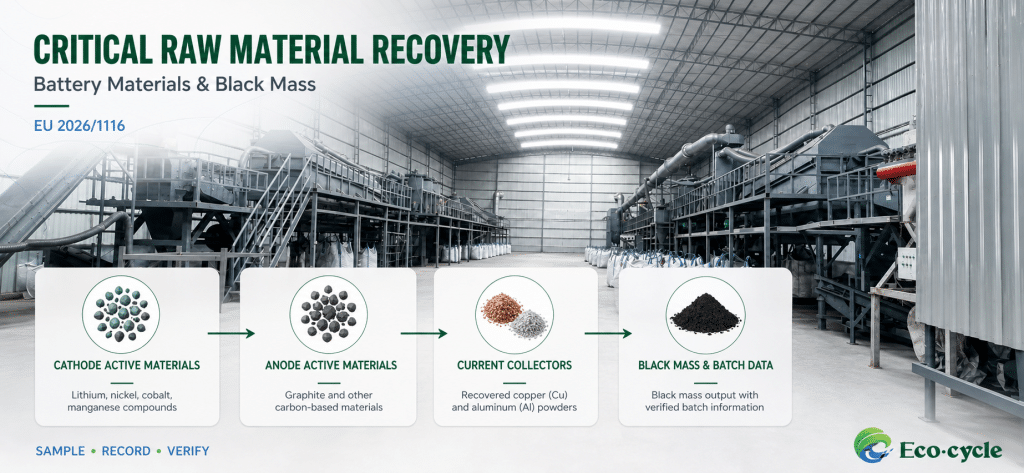
Within the battery category, the list specifically includes positive electrode active materials, negative electrode active materials, positive electrode current collectors, negative electrode current collectors, battery management systems, and internal cables.
The regulation also notes that some materials may exist as mixed components formed after specific end-of-life treatments, such as black mass.
This means that battery recycling projects cannot simply understand black mass as a dark-colored powder.
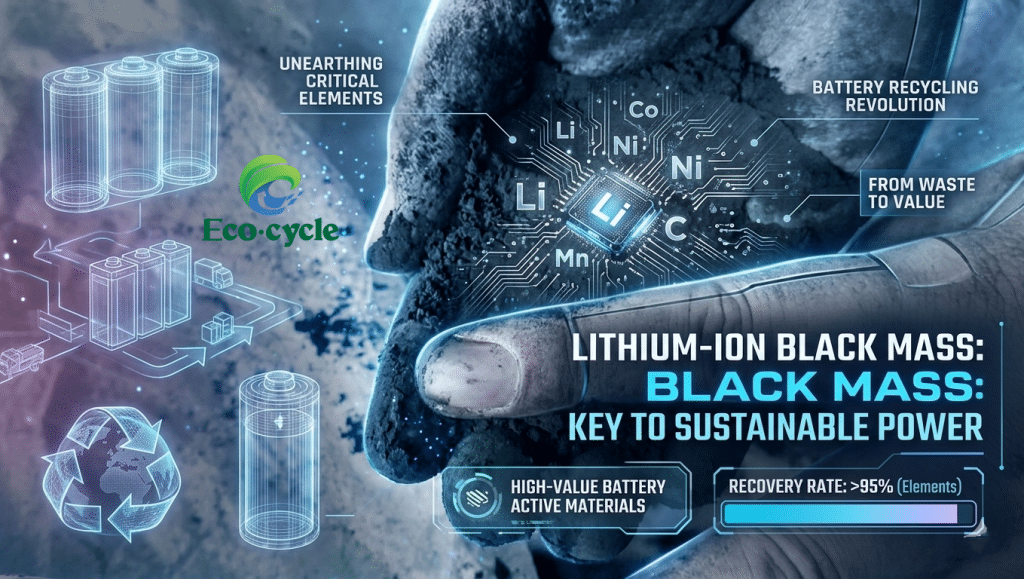
The actual material value of black mass is closely related to the type of battery it comes from, the active materials it contains, and the amount of metals and other impurities mixed in.
First, it is necessary to confirm the source of the black mass.
Black mass from NMC, LFP, or LCO battery systems may differ significantly in material composition and subsequent utilization.
Black mass from battery production waste, retired battery cells, or hybrid battery raw materials may exhibit varying batch stability and impurity levels.
Second, it’s crucial to distinguish between active materials and other components.
After mechanical processing, black mass may contain both positive and negative electrode active materials, and may also introduce copper, aluminum, iron, separator impurities, or other fine impurities.
If the initial crushing, screening, and sorting conditions are unstable, cross-contamination between different materials may increase, affecting subsequent material analysis and utilization.
Third, clear sampling and batch records are essential.
Each batch of black mass needs to be linked to its corresponding feed source, chemical system, processing date, and production conditions.
When sampling, attention should be paid to the representativeness of the sample to avoid judging the entire batch based solely on the surface or a small amount of powder.
Fourth, it’s necessary to clearly define the downstream processing path the black mass will take.
Different customers may focus on different indicators, including material system, moisture content, particle size, copper and aluminum impurities, batch consistency, and packaging method.
Therefore, recycling production lines cannot simply address “how to collect black mass”; they also need to provide suitable conditions for weighing, sampling, testing, packaging, and batch traceability.
The EU’s Critical Raw Material Recycling List reinforces the strategic value of battery active materials and related components.
However, inclusion in the list does not mean that all black mass has the same quality, nor does it mean that any batch of black mass will automatically meet downstream requirements.
Truly verifiable recycling results require clear raw material information, stable mechanical processing, independent material collection, and continuous batch data.
ECOCYCLE Machinery can discuss production line configurations for crushing, screening, black mass collection, and copper-aluminum separation based on the condition of battery production waste, retired cells, and other lithium battery raw materials.